
ChimanaTech RAS-One
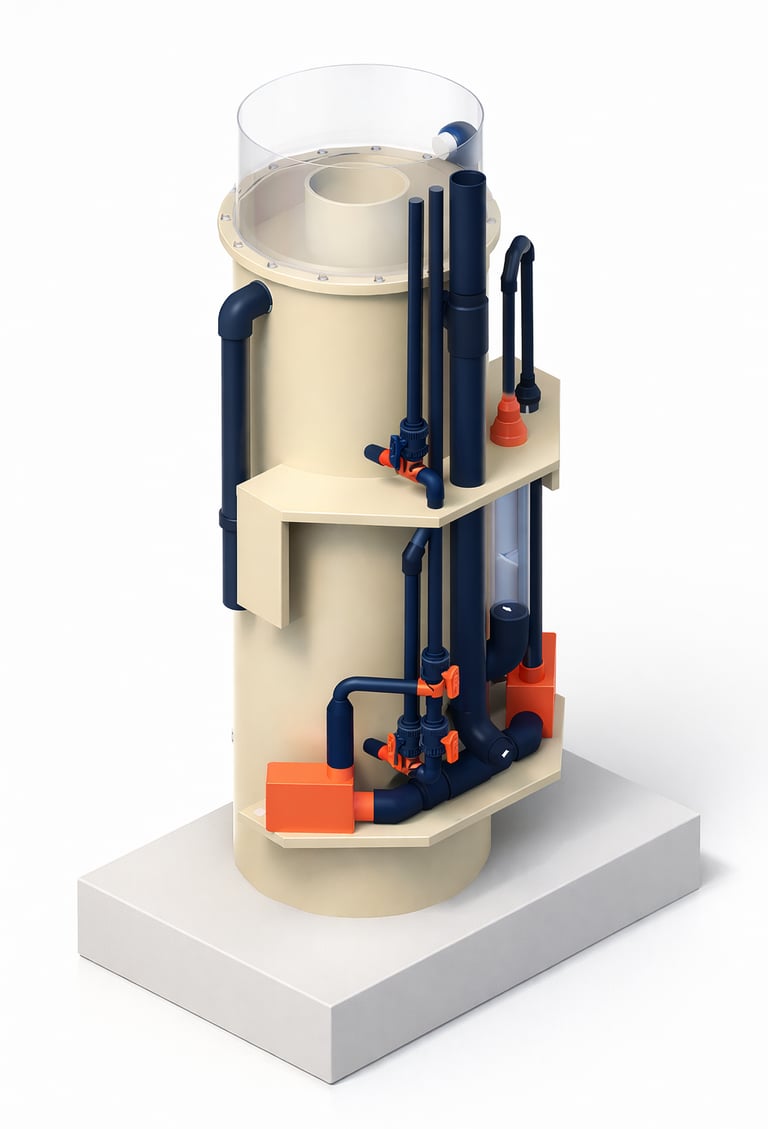
How it works
Water enters at the top of the vessel and is stripped of CO₂ with diffused aeration.
Water flows down a biomedia bed, where nitrification occurs
At the bottom, water enters a second chamber where oxygenation is achieved with a down-flow oxygen saturator.
Water exits through an overflow at the top, by gravity.
Additional functions
Protein skimming: intense aeration for CO₂ strpping may produce foam. Excess foam escapes through the crown outlet at the top. Excess foam can also be pushed out by increasing the water level in the system.
Microparticle filtration: depending on user preference, the biomedia can be stirred gently for a moving bed bioreactor function, or left still as a fixed bed biofilter. In fixed bed biofilter mode, the biofilter traps fine solids. This can be used to aid in particle filtration.
RAS-One requires a mechanical filtration step upstream e.g. sand filters, bead filters or drum filters + pump sump.
Models
S - Standard
Standard RAS-One for research, hatcheries and pilot applications. Capacities from 1 to 5kg of feed per day and flows from 3 to 30m3/h.
C - Commercial
For RAS farms and large aquacultuee facilities. Capacities from 20 to 70 kg of feed per day and flows from 120 to 500m3/h.
A - Aquatics
For home, laboratories, restaurants and small live holding facilities. >1 kg feed per day and >3m3/h.
The core of RAS in a single device
RAS-One combines CO₂ stripping, ammonia removal, oxygenation and fine solids removal in one integrated unit. RAS-One is designed as a modules that can be deployed in applications ranging from research and hatcheries to full commercial farms.
ChimanaTech
Chimana Management BV
Hemelrijk 2A
5281PS
Boxtel
The Netherlands
carlos@chimana.tech
+31 612 769 754
© 2025. All rights reserved.