
Case Study: Applying intensive RAS know-how to improve live holding systems.
Depuration facilities are deceivingly intensive.
Carlos & Maddi
5/20/20263 min leggere
The "oh no" moment
Maddi Badiola (HTH Engineering, Basque Country) and I have been recently started working in a segment of the industry only touched briefly many years ago: live holding and trading of bivalves, mollusks, and crustaceans. It is a large, mature, and complex part of the seafood supply chain in the South of Europe.
On the surface, the sector looks simple: you move live animals from point A, keep them for a few days, then sell them to client at point B. Animals come unfed and are kept in cold water to keep their metabolism low. Our assumption that these holding systems were "lightly loaded" or "clean" broke down when we started learning about the logistics and challenges of live seafood trading.
What is worse, we discovered that the players in this chain may be as wrong as we were.
In a classical mussel depuration system, low loading holds true: healthy stable mussel supply coming from clean, open water farms, easily kept with a few biofilters and protein skimmers. The reality is that these systems are increasingly being used to import and trade species from every location and environment possible: oysters dredged from silty seabeds, clams flown from the Americas under stress, mussels from the Galician rias stressed by climate change and cold chains stressed by warmer summers. The mortality rates reported , across the entire chain, are of 20–50%.
In finfish aquaculture, these numbers lead to business failure. Here, the loss is passed to you, at the restaurant table. The value chain actors we contacted through this work are well aware that this is unsustainable, but they seem to lack the tools and know-how to improve the situation.
The intervention after the diagnosis
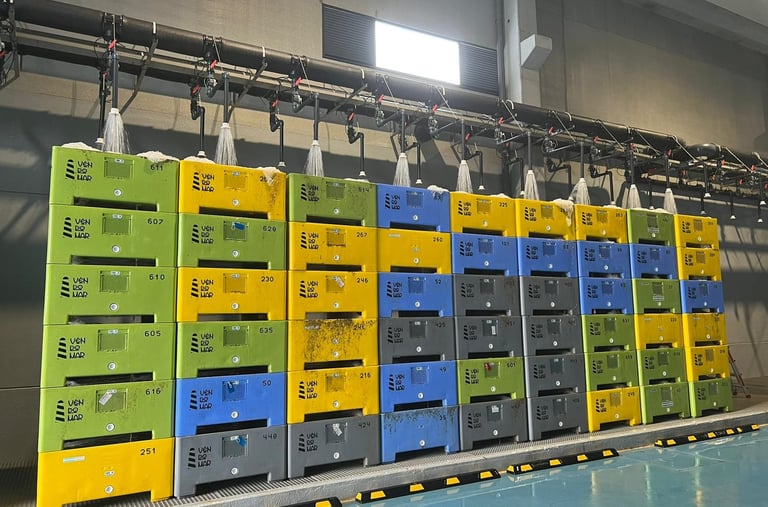
In this project, we reviewed a bivalve depuration and holding facility in Spain. Initially, it works for its original purpose. But, the seafood trading landscape is changing.
The result is chronically unstable RAS, akin to what we see among poorly managed finfish rearing systems in our corner of the sector. We were reported:
* Elevated ammonia and nitrite levels
* Solids accumulation
* Alkalinity-depleted process water
* Localized anaerobic zones inside the system where nitrite formation occurs
* Large episodic nitrogen spikes driven by mortality events
* And a chronically larger nitrogen load caused by the import of stressed animals
To help the client through sleepless nights, we first focused on pulling the largest levers first:
1) We implemented strict and frequent cleaning as a scheduled operational routine.
2) We reworked incoming product handling protocols, including immediate rejection of visibly compromised batches. Our client took a step further and now refuses to purchase animals from origins known to be under temporary climate stress or known to be producing stressed animals.
3) On the water chemistry side, we restored alkalinity using controlled supplementation and implemented daily and weekly monitoring routines for biofilter performance.
Results so far:
1) Ammonia dropped from ~2–3 mg/L to effectively zero.
2) Nitrite fell from 3–5 mg/L to ~0.1 mg/L.
3) Alkalinity recovered from below 70 mg/L CaCO₃ equivalent to approximately 130 mg/L.
4) Mortality was largely eliminated, and product stability improved enough that the client began seeing better acceptance and quality perception at market level, even from identical origin stock compared to other facilities.
Our client is now a sharp RAS operator which also happens to sleep better at night.
But what about Christmas?
For the next phase we are improving the robustness of the system:
First, conditioning existing biofilters to tolerate peak loads and sudden shock events.
Second, reducing total gas pressure. A parameter which, although critical in hatcheries and RAS, has been overlooked by both academia and industry when it comes to bivalves.
Third, increasing total biofiltration capacity for the summer and December seasons, where biomass can double in a couple of weeks.
And fourth - profitability analysis pending -, introducing denitrification to reduce the cost water and alkalinity supplementation.
Closing remarks
What is interesting here is how deceiving an "unfed" depuration system can be. An operational hiccup, and you are left handling several kilograms of TAN in the water, equivalent to hundreds of kilograms of fish feed!. But, the system still allows for small engineering interventions to have disproportionate impact on stability, quality and survival.
Economically, it is very easy to notice the how beneficial interventions can be. In finfish RAS, have to wait anywhere between 6 and 24 months to measure the true economic performance of a batch of fish. In these systems, 2 weeks is all that is needed.
More broadly, what this project has highlighted is that this sector is sitting on a large opportunity to improve welfare, economics and product quality. This includes holding facilities at export locations, holding / depuration facilities in import markets and even live holding facilities at the restaurants themselves. From a consulting perspective, it is also a rare situation where relatively modest technical interventions can have immediate impact.
We hope to be able to reach more players across this value chain and help them keep and supply healthier, better-quality seafood.
ChimanaTech
Chimana Management BV
Hemelrijk 2A
5281PS
Boxtel
The Netherlands
carlos@chimana.tech
+31 612 769 754
© 2025. All rights reserved.