
A cheaper RAS for these trying times?
Here's some more design explorations in my quest to reduce CAPEX in RAS. This time, a no-compromise RAS module that can be cheaply built in plastic or out of repurposed fish tanks.
Carlos
1/29/20262 min read
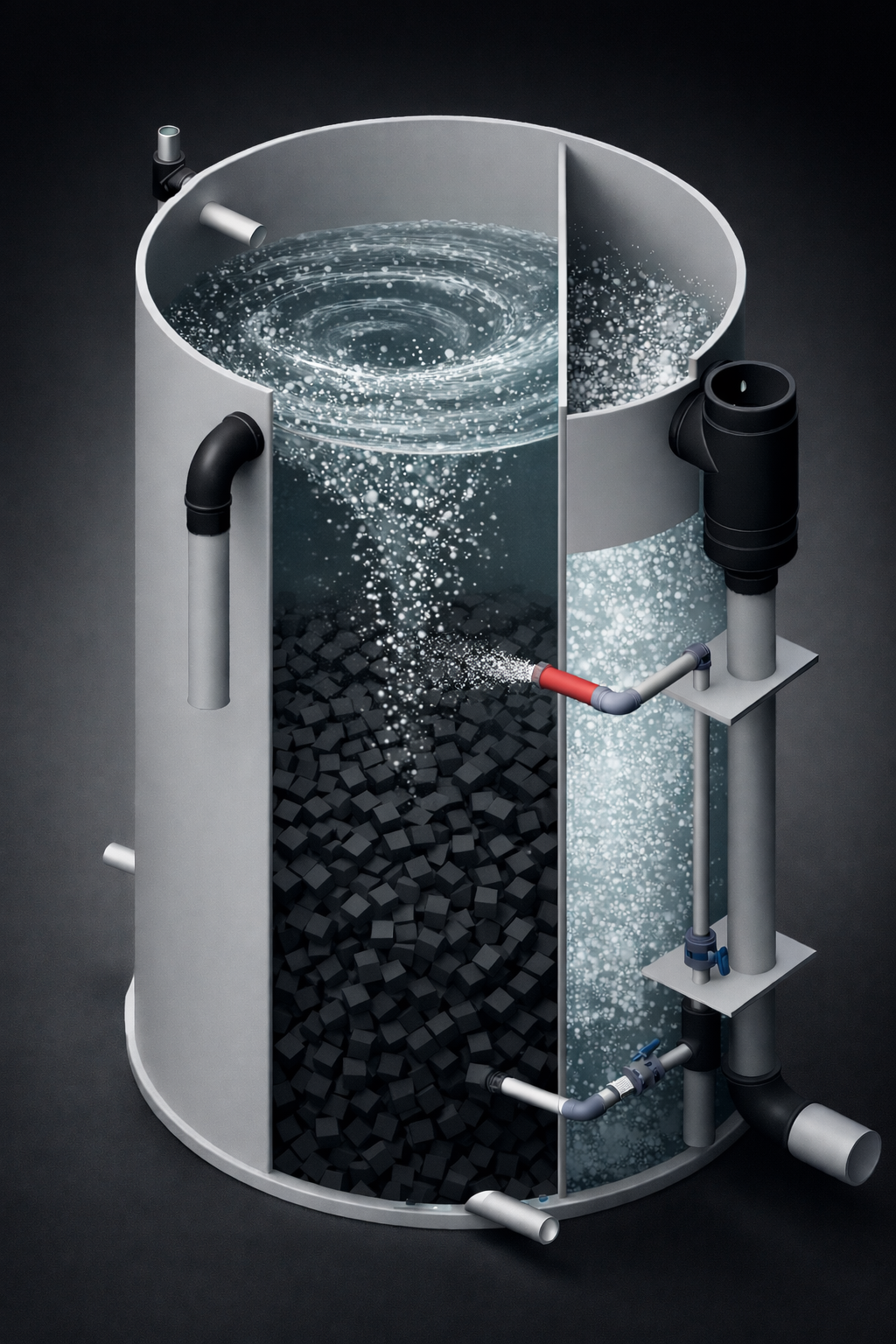
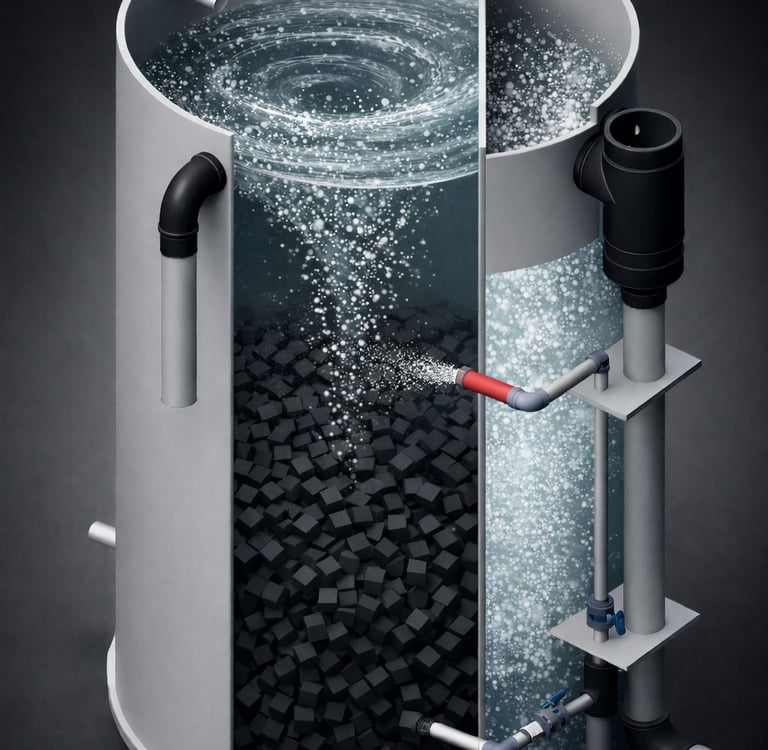
Disclaimer: use of AI to render some original CAD work.
I have been spending the last few weeks trying to imagine what would be the most affordable RAS module that can do all the main processes (carbon dioxide stripping, removal of suspended solids and fine particles, TAN oxidation and oxygenation) and without the use of ozone. As much as I love ozone, installing, running and maintaining ozone generation equipment is sometimes too much for short-handed and money-strapped teams.
I looked at the last paper from Laura Bailey and Brian Vinci on degassing basins to work with some empirical data, and dusted away some old knowledge on fixed bed biofilters and came up with the following.
- First a mechanical filtration step downstream of the fish tanks is the designers' choice. I'd opt for bead filters or glass media filters in small scale RAS. Then, the core of the system:
- A cylindrical vessel - cheap, easy to build. Large tanks can be repurposed for this.
- At least 2m deep. This provides enough depth for degassing and head for gravity return to tanks in case this is planned for.
- The secret sauce: there is a point where the low end of the range for hydraulic loading rates used in a degassing basins meets the design hydraulic loading rates for a fixed bed biofilters. Et voila! Both processes can theoretically occupy the same vessel. Water enters at the top, gets degassed, flows through a media bed removing TAN and trapping fines, and its ready to be oxygenated.
- Downstream, the approach is perhaps more opinionated because oxygenation is flexible. In my opinion, a riser with ceramic diffusers can provide oxygen as the water finds it exit at the top of the vessel. Not the most efficient single-pass, but cheap.
Last, more refinements can be added: aspirators to inject bubbles tangentially instead of using aeration grids; some form of sparging or stirring the fixed bed for periodic cleaning, adding extra loops such as ozonation or more efficient oxygenation, and so on.
If you are interested in developing and testing this concept with me, send me a note! I will be packaging this into a kit for site assembly in small scale applications of a few kg of feed per day.
For large scale developments, let's talk!
ChimanaTech
Chimana Management BV
Hemelrijk 2A
5281PS
Boxtel
The Netherlands
carlos@chimana.tech
+31 612 769 754
© 2025. All rights reserved.